Simple Wedding Ceremony Script
Use a simple wedding ceremony script with warm officiant wording, clear stage directions, and options for personal vows, rings, and the pronouncement.
Simple wedding ceremony script decisions
Keep a wedding ceremony script short without making it generic
A simple wedding ceremony script needs fewer sections, not emptier language. Keep the welcome, declaration of intent, vows, rings, and pronouncement; then personalize one compact passage about the couple and one transition into their promises. Confirm local legal wording before rehearsal and place stage directions where actions occur. The sample below is designed to be spoken slowly in roughly ten to fifteen minutes, with optional sections clearly separated so the couple can add meaning without losing control of timing.
This simple wedding ceremony script creates a warm, non-denominational ceremony of about 10 to 15 minutes before optional readings or longer personal vows. Replace every bracketed instruction, confirm the legal wording with the officiant, and rehearse the final version aloud.
For alternate structures, visit the wedding ceremony scripts guide. To create a version using your names, timing, traditions, and story, open the Wedding Ceremony Script Generator.
Before using any sample script
A ceremony template is not legal advice. Marriage rules differ by country, state, province, county, and faith community. The officiant is responsible for confirming registration, license, witness, declaration, pronouncement, and filing requirements with the correct local authority.
Ask the couple to approve names, pronouns, relationship details, humor, and any acknowledgment of family or absent loved ones. Never surprise them with a sensitive story during the ceremony.
Simple ceremony script
Processional
[Music begins. The officiant takes position. The wedding party and couple enter according to the rehearsal plan. When everyone is in place, the music fades.]
OFFICIANT:
Welcome. Please be seated.
We are here to celebrate the marriage of [Partner One] and [Partner Two]. Today they make a public promise to continue the life they have already begun building together, supported by the people who know and love them.
[Pause and look at the couple.]
Opening remarks
OFFICIANT:
Marriage is made from large promises and ordinary choices. It asks two people to tell the truth, to listen with care, to share responsibility, and to keep learning who the other person is becoming. It also makes room for friendship, laughter, rest, and the daily rituals that turn a place into a home.
[Partner One] and [Partner Two], the people gathered here have witnessed parts of your story. Today they witness the choice at its center: to meet the future as partners.
Optional couple story
OFFICIANT:
[Add 150 to 250 words about one or two moments that show how the couple works as a team. End by connecting the story to the promises they are about to make.]
Keep this section brief. A useful story has a setting, an action, and a quality it reveals. Avoid a complete dating timeline.
Declaration of intent
OFFICIANT:
[Partner One], do you come here freely to marry [Partner Two], and do you intend to share your life with them in honesty, care, and partnership?
PARTNER ONE: I do.
OFFICIANT:
[Partner Two], do you come here freely to marry [Partner One], and do you intend to share your life with them in honesty, care, and partnership?
PARTNER TWO: I do.
[Replace this language if local law requires a particular declaration.]
Vows option A: personal vows
OFFICIANT:
You have chosen to speak promises in your own words. [Partner One], please share your vows.
[Partner One reads. Pause.]
[Partner Two], please share your vows.
[Partner Two reads. Pause.]
Vows option B: repeat-after-me vows
OFFICIANT:
[Partner One], please repeat after me.
I choose you as my partner. / I promise to speak honestly and listen with care. / To share the work and the joy of our life. / To support your growth and protect our connection. / And to keep choosing our marriage through every season.
[Repeat for Partner Two.]
Choose either option A or B, or combine brief personal statements with a traditional vow approved by the officiant. Do not leave both full options in the ceremony copy.
Ring exchange
OFFICIANT:
May I have the rings?
[The ring holder steps forward or hands the rings to the officiant.]
These rings are visible reminders of promises renewed through daily action.
[Partner One], place the ring on [Partner Two] and repeat after me:
I give you this ring / as a sign of my love / and the promises I make today.
[Repeat for Partner Two.]
Pronouncement
OFFICIANT:
[Partner One] and [Partner Two], you have declared your intent, spoken your vows, and exchanged rings before the people gathered here. [Insert the pronouncement wording that is legally and personally appropriate.]
It is my joy to pronounce you married. You may celebrate with a kiss.
[The officiant steps aside. The couple kisses.]
Presentation and recessional
OFFICIANT:
Everyone, it is my honor to present [the couple's preferred introduction].
[Music begins. The couple exits, followed by the wedding party.]
Personalize the script without making it longer
Change three places first:
- Replace the opening definition of marriage with values the couple actually shares.
- Add one compact story that demonstrates partnership.
- Write ring words or a closing line that echoes an image from that story.
Those changes make a ceremony recognizable without adding several readings or rituals. For a secular version with more alternatives, use the non-religious wedding ceremony script.
Format the officiant copy
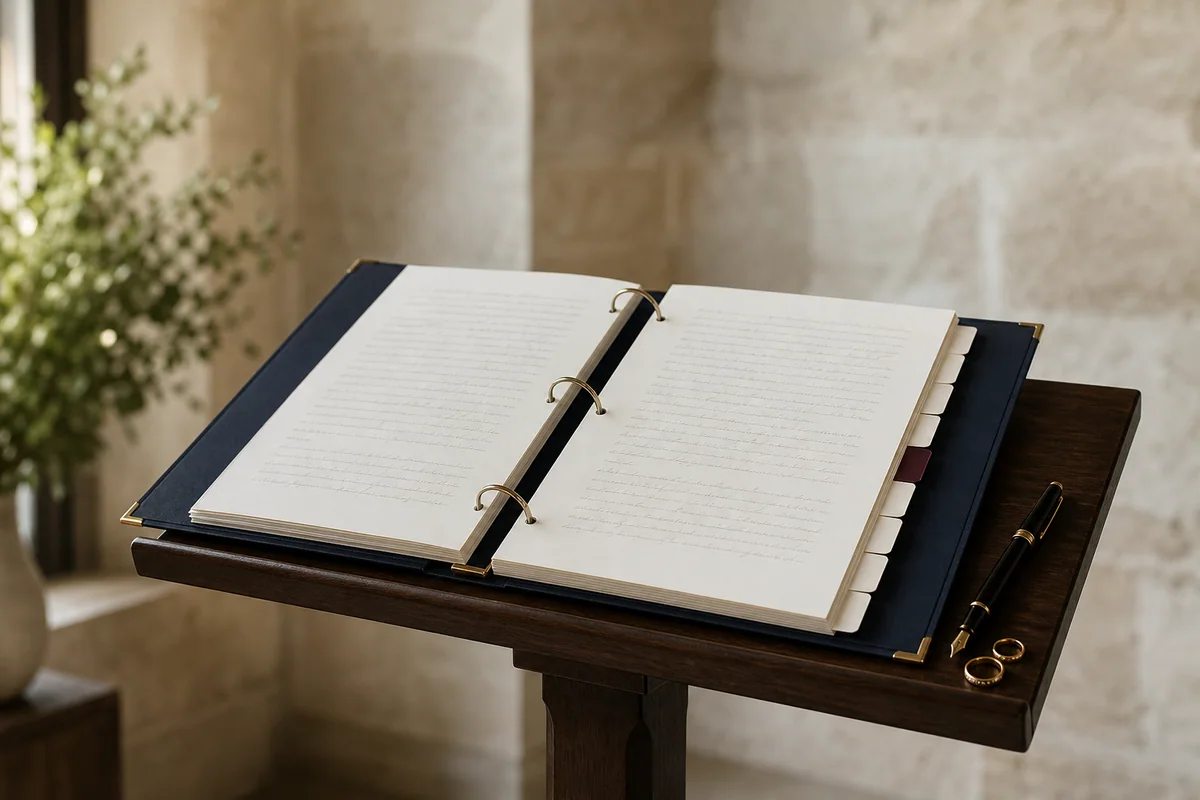
Use large type, generous spacing, and page breaks between major sections. Put stage directions in bold or a contrasting color. Spell difficult names phonetically and mark where the officiant should pause, move, or step aside.
The wedding ceremony order guide can serve as the rehearsal checklist. Print one clean ceremony copy, one backup, and a separate copy with vendor cues if the coordinator needs more operational detail.
Rehearse for calm delivery
The officiant should practice aloud at least twice before the rehearsal. Time the full script, not just the spoken paragraphs. At the venue, rehearse entrances, reader movement, ring handoffs, microphone position, and the couple's exit.
Optional sections to add deliberately
Add a reading when a particular voice or text contributes something the officiant remarks do not. Introduce the reader, include the selection title and author, and write [Reader returns to seat] before the next transition. One well-rehearsed reading is usually more effective than several unrelated quotations.
For a remembrance, agree on the wording with the people most affected. A concise option is: “We also hold in our thoughts the people whose love shaped this day and whose absence is deeply felt.” Name individuals only with family approval.
A community vow can follow the couple's vows:
Will all of you gathered here encourage this marriage with honesty, welcome, and care?
GUESTS: We will.
Print or announce the response so guests are ready. Do not ask them to make a complex promise without context.
Unity rituals need both meaning and logistics. Add one sentence explaining the symbol, then stage directions for every object and participant. Test candles outdoors, pre-loosen container lids, and decide who removes the table after the ceremony. If the action needs several minutes of silent setup, add music or shorten it.
When children are included, write promises adults can responsibly make: steadiness, respect, listening, and care. Avoid asking a child to make a public promise or using wording that replaces another parent. Review the section with everyone who shares parental responsibility.
Each optional element should answer a clear question: whose voice is missing, which value needs expression, or which community should be recognized? If it only fills time, the simpler script will usually feel more intentional.
A simple ceremony feels effortless when every necessary cue is present and every unnecessary sentence has been removed.