Funny Vows on Wedding
Write funny Vows on Wedding that still feel sincere, using safe joke patterns, boundaries to discuss, and balanced ceremony-ready examples.
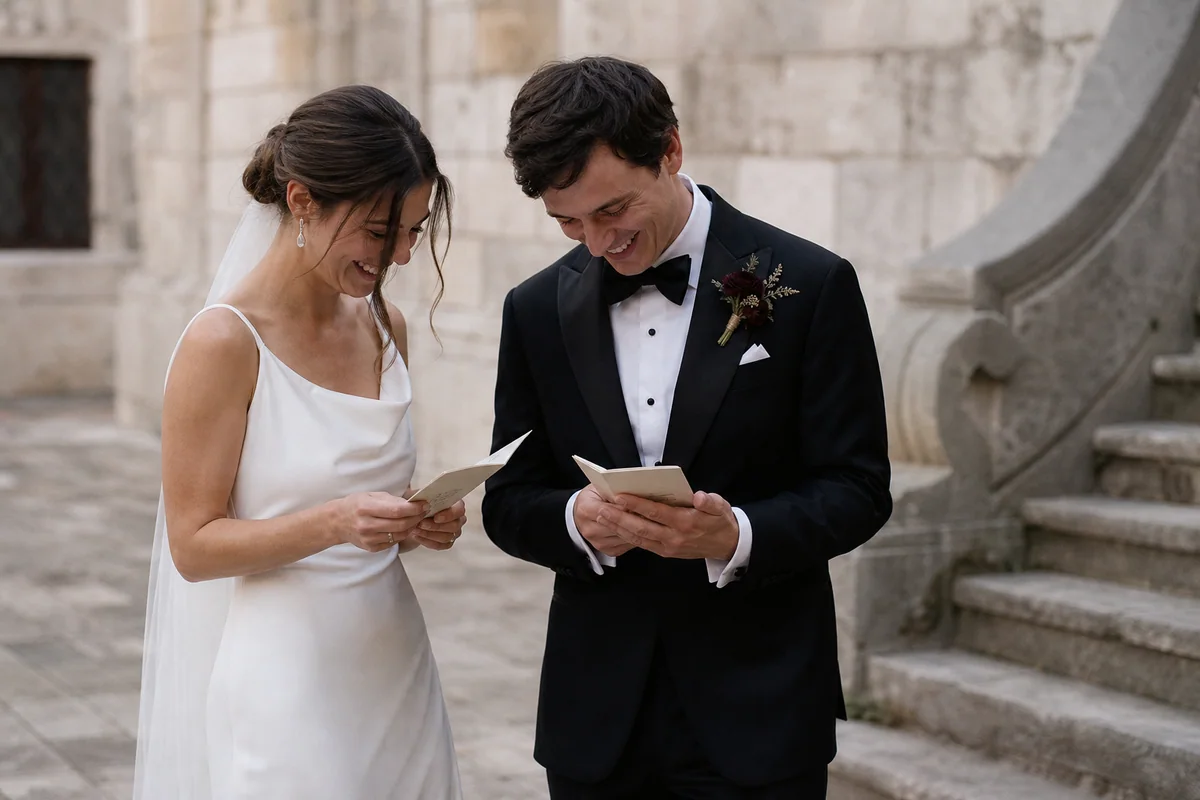
Funny Vows on Wedding need a clear safety rule
Make Vows on Wedding humor affectionate and recognizable
Funny Vows on Wedding should let the partner feel more loved after the laugh, not more exposed. The safest material points toward a shared habit, a gentle contrast, or the speaker’s own limitation, then turns toward a sincere promise. Agree on boundaries before drafting and remove jokes about insecurity, former relationships, family conflict, money, bodies, health, or anything the partner has not approved for the room. Humor is a tonal accent; the commitments remain the center of the vows.
Funny wedding vows work when the humor reveals affection and the promises remain sincere. The safest jokes are about shared habits, the speaker's own quirks, or harmless differences the couple already laughs about. The riskiest jokes expose a private insecurity, criticize the partner, or depend on a story the partner did not agree to share.
This guide focuses on humor, while the wedding vows hub covers structure, examples, and length. You can also use the Wedding Vow Generator to draft a warm version first, then add only the jokes that pass the boundary checks below.
Agree on the comedy level first
“A little funny” can mean different things. One person may imagine a single line about loading the dishwasher; the other may imagine a five-minute roast. Before writing, decide:
- whether jokes about each other are welcome;
- which topics are private;
- whether family, former relationships, money, health, or embarrassing stories are off-limits;
- whether the ceremony should feel mostly sincere, evenly mixed, or openly playful;
- whether someone trusted should review both drafts for balance.
This conversation does not spoil the surprise. It makes the surprise safe.
Use humor that points toward love
Good vow humor performs at least one useful job. It can show familiarity, release emotion, or make a serious promise feel recognizably yours.
A shared-habit joke
I promise to leave you the last dumpling at least half the time, and to be honest when I already ate it.
The habit is small, mutual, and easy for guests to understand.
A self-directed joke
I promise to ask for directions before we have passed the same gas station three times.
The speaker is the target, so the partner is not placed in an uncomfortable public position.
A harmless contrast
I promise to respect that arriving exactly on time feels early to me and dangerously late to you.
The difference is framed as shared knowledge, not a character defect.
A joke that becomes a real promise
I promise to learn which decorative towels are for looking and which towels we are actually allowed to use—and, more importantly, to keep making our home a place where both of us can rest.
The turn from light to sincere gives the line emotional purpose.
Keep the ratio in favor of sincerity
A useful editing target is one humorous beat for every two or three sincere beats. That does not mean counting jokes mechanically. It means ensuring the vows would still communicate commitment if the audience did not laugh.
The essential structure remains:
- a direct statement about your partner;
- a specific observation or memory;
- several real promises;
- a closing commitment.
Humor can appear in the observation and one or two promises. The closing usually deserves a clear emotional landing.
For a full outline, use How to Write Wedding Vows. For realistic timing, read How Long Should Wedding Vows Be?.
Jokes to remove from public vows
Cut a joke if it relies on:
- sexual details or private nicknames the partner has not approved;
- a former partner or comparison with a past relationship;
- doubts about getting married, divorce, or being “trapped”;
- drinking, debt, employment, body image, fertility, health, or family conflict;
- the partner's mistake during a painful event;
- a stereotype about gender, culture, religion, disability, or identity;
- the audience laughing at the partner rather than recognizing the couple.
Also remove jokes that need a long setup. A vow is not a stand-up set, and a confused audience creates tension instead of warmth.
Test every joke three ways
The private-room test
Would your partner laugh if you said the line at home without an audience? If not, public delivery will not improve it.
The silent-room test
Can you continue comfortably if nobody laughs? Avoid wording that requires a pause for applause or makes the next sincere line depend on a reaction.
The future-video test
Will the joke still feel affectionate when you watch the ceremony years later with relatives or children? Timely references can be fun, but humiliation ages badly.
A balanced funny vow example
Nina, you make our life kinder, louder, and much better organized. From the beginning, you have believed in every ambitious plan—including the ones that started with me saying, “This should only take an hour.” I promise to read the instructions before declaring them unnecessary, to bring you coffee without asking whether you want it, and to keep making space for the adventures we have not imagined yet. I promise to listen when life is serious, apologize without adding a footnote, and choose our team over being right. I love the life we laugh through together, and I choose you for all of it.
The humor is specific but gentle. It transitions into promises about listening and repair, and it ends sincerely. More tonal patterns appear in wedding vow examples by style.
Edit for delivery
Read the draft to one person who understands both your humor and your partner's boundaries. Ask two concrete questions: “Does any line sound like a criticism?” and “Do the promises still feel like the center?”
During the ceremony, do not rush a joke, but do not wait theatrically for laughter either. Smile at your partner, let the response happen, and continue. The moment belongs to the two of you even when guests are listening.
Turn a roast-style line into affectionate humor
Many first drafts contain a line that is funny among friends but too sharp for vows. Keep the recognizable situation and change who carries the cost of the joke.
Sharp version:
I promise to keep cleaning up after you because you will clearly never learn.
Affectionate version:
I promise we will keep negotiating the mysterious journey from a coffee cup to the dishwasher—and that I will remember my shoes have a home too.
The revision makes the problem shared and lets the speaker include their own habit.
Sharp version:
I knew I loved you even though you are always late.
Affectionate version:
I love that you notice every person in the room, even if it means we arrive with exactly thirty seconds to spare. I promise to build in the extra ten minutes and enjoy the people you notice along the way.
The revised line identifies the generous quality underneath the habit and turns it into a practical promise.
Sharp version:
I promise not to divorce you over your terrible taste in movies.
Affectionate version:
I promise to watch your spectacularly questionable science-fiction picks, as long as you keep pretending not to love my baking shows.
Removing threats about divorce keeps the joke inside a safe, mutual ritual.
Use the same method throughout the draft: identify the affectionate truth, include yourself in the imperfection, and connect the laugh to a promise. If the line cannot survive that rewrite, it probably belongs in a private toast—or nowhere.
The goal is not to prove that you are the funniest couple in the room. It is to let the room recognize the joy already present in your relationship.
When tenderness remains clear, the laughter will feel like part of the promise rather than an interruption.