Vows on Wedding: How to Write Vows
Use this Vows on Wedding framework to turn memories and commitments into personal promises with an outline, editing checklist, and ceremony-ready example.
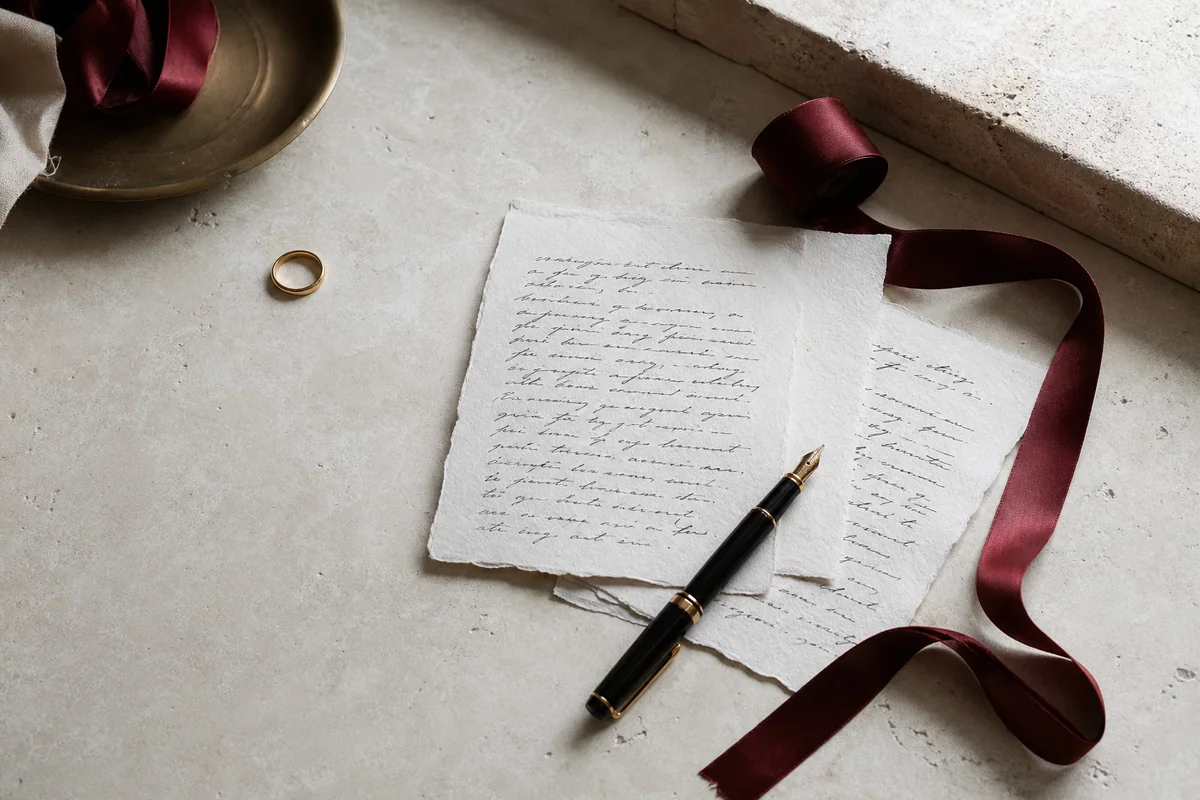
Vows on Wedding writing plan
Why a Vows on Wedding framework prevents generic promises
A Vows on Wedding draft becomes personal when every broad feeling is supported by a recognizable memory or behavior. This guide treats the work as a sequence: agree on boundaries, collect specific material, choose one relationship truth, make promises that describe married life, and edit for speech. That order keeps the blank page from becoming a search for impressive language. It also gives both partners a shared standard without forcing them to reveal their final words before the ceremony.
The easiest way to write wedding vows is to stop trying to summarize your entire relationship. Choose one clear truth about your partner, one memory that demonstrates it, and three to five promises that describe the marriage you intend to build. That is enough material for personal vows that feel complete when spoken aloud.
This framework takes you from notes to a ceremony-ready draft. If you would rather answer guided questions than face a blank page, the Wedding Vow Generator can turn the same raw material into an editable first version. For the full set of related resources, visit the wedding vows writing guide.
Step 1: Agree on the boundaries together
Before writing separately, spend ten minutes agreeing on the experience you want to create. Decide:
- an approximate speaking time;
- whether the tone is sincere, playful, formal, or mixed;
- whether personal stories and inside jokes are welcome;
- whether you will share drafts with each other or a trusted reviewer;
- whether traditional vows will also be included.
These agreements prevent the common mismatch where one partner delivers a two-minute personal promise and the other delivers a seven-minute comedy monologue. You do not need identical formats, but the vows should feel as if they belong in the same ceremony.
If timing is uncertain, use the ranges in How Long Should Wedding Vows Be? before drafting.
Step 2: Collect specific material
Write short answers to these prompts without editing them:
- What did you misunderstand about your partner when you first met?
- When did the relationship begin to feel like a lasting partnership?
- What ordinary habit makes daily life better?
- What difficult season showed you how the two of you work as a team?
- What quality do you hope never changes?
- What three actions can you honestly promise for the future?
Specific details are more useful than dramatic adjectives. “You make coffee before I remember the morning exists” gives the listener a picture. “You are amazing in every possible way” does not.
Do not force yourself to use the most emotional story. Choose a memory that can be understood quickly by guests and that your partner will be comfortable hearing in public. Save sensitive family details, former relationships, health information, and stories that require a long explanation for a private letter.
Step 3: Build a five-part outline
Use this order for a reliable first draft:
1. Address your partner
Begin with their name and a direct statement. For example: “Jordan, you are the person who makes every place feel like home.” This settles the speaker and tells the audience what the vows are about.
2. Name one relationship truth
Describe what you have learned about the partnership: “Life with you is not effortless, but it is honest, generous, and always worth choosing.” Avoid claiming perfection. Credible affection is stronger than exaggerated praise.
3. Tell one compact story
Give the setting, the meaningful action, and what it revealed. Two or three sentences are enough. The story supports the relationship truth; it is not a separate speech.
4. Make specific promises
Use active language. “I promise to ask what you need before assuming” is clearer than “I promise to be supportive.” Mix lasting commitments with everyday care:
- a promise about listening or repair;
- a promise about shared responsibilities;
- a promise about joy, curiosity, or play;
- a promise that reflects your actual relationship.
The promises are the core of the vows. A declaration of love without commitments can sound like a toast rather than a vow.
5. Close with a durable commitment
End on the future: “I choose you as my family and my partner, today and through every version of the life ahead.” The final line should be comfortable to say slowly and without explanation.
Step 4: Write badly on purpose
Your first draft only needs to exist. Write the outline in plain language and leave awkward sentences in place. Trying to make every line beautiful while drafting usually creates vague, formal wording that does not resemble your voice.
Once all five parts are present, underline the details that could only belong to your relationship. If very little is underlined, replace general claims with a memory, habit, place, or choice. Examples can help you recognize structures, but read wedding vow examples by tone as models rather than scripts to copy.
Step 5: Edit for speech
Print the draft or increase the text size, then read it aloud at a natural pace. Mark every place you run out of breath or stumble. Shorten long sentences, remove repeated ideas, and replace words you would never use in conversation.
Use these editing questions:
- Does the first sentence sound like me?
- Can a guest understand the story without extra context?
- Are the promises concrete and possible to keep?
- Is any joke aimed at my partner instead of shared with them?
- Have I repeated the same idea in different words?
- Does the final line feel like a commitment?
Read the vows to one discreet person who knows both of you. Ask where the language sounds generic, not whether it sounds “good.” A useful reviewer protects your voice instead of rewriting it.
A complete short example
Maya, you make our life feel both steadier and more adventurous. I knew we were becoming a team on the night our apartment flooded and you somehow made a plan, found towels, and made me laugh before the water was gone. You meet hard moments with patience and ordinary days with curiosity. I promise to listen before I defend, to share the invisible work of our home, to protect time for the people and places we love, and to keep finding reasons for us to laugh. I choose you as my partner and my family, for every season we are lucky enough to share.
The example works because it moves from a clear truth to one scene, then to promises. Its details should not be reused. Replace them with your own evidence.
Final ceremony checklist
- Put the final copy on sturdy cards or in a vow book.
- Use large type and generous line spacing.
- Number multiple cards in case they are dropped.
- Give a backup copy to the officiant.
- Practice enough to know the rhythm, not enough to sound memorized.
- Pause after your partner's name and before the final promise.
Adapt the framework to your ceremony
The five-part outline can be shortened or expanded without changing its purpose. If you will also repeat traditional vows, keep the personal section to the opening truth, one compact observation, two promises, and a closing. The traditional text supplies the formal commitment; your words supply the individual voice.
For an elopement, the story can be more intimate because fewer listeners need context. For a large ceremony, choose details that can be understood from one sentence. If vows are private, write as openly as both partners prefer, but still include promises rather than turning the page into a general love letter.
In a multilingual ceremony, decide whether to repeat the whole vow in both languages or use a different portion in each. Repeating everything protects comprehension but doubles the timing. Dividing the vow can feel more natural when a translation appears in the program. Ask a fluent speaker to review meaning and pronunciation; automated translation may preserve grammar while changing emotional tone.
If speaking is inaccessible or intensely stressful, a partner can sign, use an assistive communication device, repeat short phrases after the officiant, or exchange written vows privately. The commitment is not measured by performance. Tell the officiant and sound team what format will make both partners feel present and respected.
Finally, keep a private longer version if editing the public vow feels painful. The ceremony receives the clearest promises; the letter can hold the second story, detailed gratitude, and thoughts meant for your partner alone.
Personal vows are not a writing competition. A clear, honest promise spoken in your natural voice will carry more weight than elaborate language borrowed from someone else.