Wedding Thank You Cards in Batches
Organize details and write wedding thank you cards in manageable batches while keeping every note personal with a review-safe workflow.
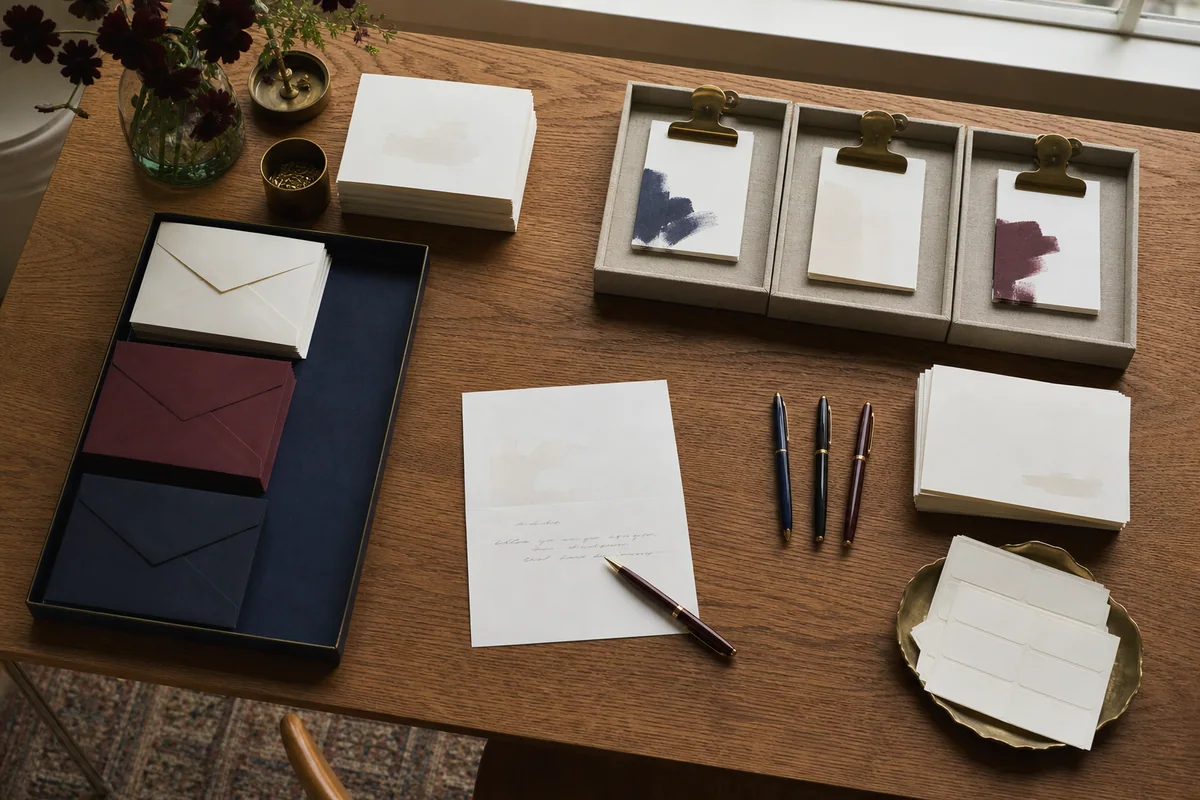
Wedding thank you cards batching with human quality control
Organize wedding thank you cards before generating sentences
Wedding thank you cards can be drafted in batches without becoming identical when recipient facts remain the center of the workflow. Build one private tracker, reconcile gifts, segment recipients by message job, and require a personal detail in every row before drafting. Generate or write one message at a time, then review names, gift facts, attendance, tone, and similarity before anything is printed or sent. The system below reduces administrative repetition while keeping final responsibility with the couple.
The safest way to write wedding thank-you cards in batches is to organize recipient-specific facts first, generate or draft one message per row, and review every card before sending. Batch work should reduce administrative repetition; it should not make the messages identical.
This workflow is designed for dozens or hundreds of recipients. Visit the wedding thank-you cards guide for wording and etiquette, or use the private Wedding Thank-You Card Generator to import a CSV and create editable drafts.
1. Build one private source of truth
Use a spreadsheet that only the couple and necessary helpers can access. Recommended columns are:
recipient_namerecipient_typeattended_weddinggift_typegift_descriptionrelationship_detailsspecial_memorymessage_to_includeaddress_confirmeddraft_reviewedmailed_date
Use the exact columns required by your chosen import tool, but keep the ideas separate. A gift description answers “what did they give?” while a special memory answers “what personal connection should the note include?” Combining both into one vague cell creates vague messages.
Protect this file. It may contain names, addresses, financial-gift descriptions, family relationships, and private memories. Do not publish it, attach it to a public support request, or paste the entire list into an untrusted tool.
2. Reconcile gifts before drafting
Compare physical cards, registry notices, delivery emails, checks, fund records, shower lists, and notes from the person who collected gifts at the venue. Standardize household names and confirm who contributed to group gifts.
Mark uncertainty instead of guessing. Create a short follow-up list for:
- gifts with no sender;
- senders with no clear gift record;
- duplicate registry notices;
- group gifts with incomplete contributor names;
- addresses that may have changed.
Resolve these items before generating text. A polished card thanking someone for the wrong gift is worse than a plain accurate note.
3. Segment by message job
Group recipients by the kind of thanks required, not by how close they are to the couple. Useful segments include:
- registry or household gifts;
- cash and fund contributions;
- handmade or heirloom gifts;
- wedding party and helpers;
- hosts and family contributors;
- vendors;
- attendees with a meaningful non-gift contribution;
- people who sent gifts but could not attend.
Segmentation helps the writer maintain the right structure for a session. It should not turn into one template copied across the group. The article on thank-you wording by gift type provides distinct starting patterns.
4. Fill the personalization fields
Every row should contain at least three usable specifics:
- the gift, action, or presence being thanked;
- why it mattered or how it will be used;
- one relationship detail, wedding memory, or future connection.
Weak row:
Jamie | friend | gift | attended
Useful row:
Jamie Chen | college friend | blue serving bowl | using it for Sunday pasta dinners | attended | helped calm the flower child before processional | hope to visit Chicago in fall
The second row can produce a message that no other recipient receives.
5. Draft in small sessions
Choose a batch size that preserves attention. Ten to fifteen cards per writer is often manageable; the right number may be lower when notes involve sensitive family relationships or complex contributions.
Work in this order:
- draft the complete batch;
- take a short break;
- review names and gift facts against the spreadsheet;
- read for repeated phrases;
- handwrite or print only approved drafts;
- mark the mailed date immediately.
Do not draft, address, stamp, and mail one card at a time while the master list remains open in several versions. Finish a controlled stage, then update the record.
6. Use AI as a draft layer, not an authority
A generator can vary structure and save time, but it cannot know whether the source row is accurate or whether a family detail is appropriate to mention. Review every output for:
- correct name and pronouns;
- correct gift and attendance status;
- invented memories or future plans;
- exaggerated claims;
- repetitive openings and closings;
- a tone that fits the relationship;
- private information that should not appear on a mailed card.
Never ask a tool to infer missing gifts or relationships. Missing input should produce a review task, not invented specificity.
7. Divide work fairly
Both partners should participate in a way that reflects their knowledge and available time. Common methods include:
- each person drafts notes for their own family and friends, then both sign;
- one person drafts while the other verifies addresses and gift records;
- both alternate batches and review each other's factual details;
- a trusted helper addresses envelopes but does not access private message details.
Do not default the entire project to the partner perceived as “better at writing.” The work includes data reconciliation, drafting, review, handwriting, addressing, and mailing; those tasks can be shared.
8. Prevent template fatigue
Search the batch for repeated phrases such as “Thank you so much,” “We cannot wait,” or “It meant the world.” Repetition across different cards is not visible to individual recipients, but it often signals that the writer stopped using the row details.
Vary the emphasis naturally:
- begin with the gift for one note;
- begin with the guest's travel for another;
- begin with a wedding memory for a close friend;
- use a more formal greeting for a professional or distant relative;
- use a direct, affectionate opening for immediate family.
Do not use a thesaurus to manufacture variety. Different facts create more convincing variation than different synonyms.
9. Run a final quality check
Before mailing a batch, verify:
- recipient name on card matches envelope;
- household members are included correctly;
- gift or contribution is accurate;
- attendance wording is accurate;
- no placeholder or spreadsheet code remains;
- both partners' preferred signatures appear;
- address is current and legible;
- the tracker records the mailing date.
For notes sent after a delay, use the guidance in when to send wedding thank-you cards. For guests whose contribution was presence or help rather than a gift, use attendance-only thank-you wording.
A batch example from row to card
Source row:
Dr. and Mrs. Patel | family friends | attended | honeymoon fund | museum day in Florence | gave a warm toast at rehearsal dinner | share photos at next visit
Reviewed draft:
Dear Dr. and Mrs. Patel, thank you for helping make our honeymoon museum day possible. It was one of the experiences we had most looked forward to, and we loved finally seeing the galleries we had talked about with you. Your rehearsal-dinner toast was such a warm beginning to the weekend. We look forward to sharing photos when we visit. With gratitude, Maya and Theo.
Every sentence traces back to a source field. That traceability is the standard for a safe batch workflow: automation can arrange the words, but people remain responsible for the truth.
Choose the final production method
Handwriting every note can feel personal, but legibility and completion matter more than a rule that becomes impossible at scale. Couples can handwrite the full message, print an individually generated message and add a handwritten line, or use a professionally printed card with a personal handwritten paragraph. Avoid one preprinted message sent unchanged to every household.
Test the complete card before producing a batch. Confirm that the font is readable, names and line breaks fit, ink does not smear, and the envelope can accommodate any photograph or insert. Print five approved cards first rather than discovering a layout problem after one hundred.
If handwriting, alternate writers only when both names and styles are expected. A partner can draft while the other writes, but the writer should understand every message in case a sentence feels wrong on the page. Use archival-safe pens on coated stock and allow ink to dry before stacking.
Keep the spreadsheet's status fields separate: drafted, reviewed, produced, addressed, and mailed. A printed card is not complete if it is still under a pile of envelopes. Record mailing dates in batches and keep returned mail on a follow-up list.
After completion, delete exported CSV files and drafts from shared or temporary devices according to your privacy needs. Retain only the master record needed to prevent duplicates and answer a genuine delivery question. A good workflow ends by reducing private data, not leaving copies across inboxes and downloads folders.